India stands at a decisive moment in its agricultural journey. After five decades of relying predominantly on solid chemical fertilisers—urea, DAP, MOP—the challenge before us is unmistakable: how do we produce more food with less nutrient loss, less freshwater use, and lower greenhouse gas emissions, while restoring and safeguarding soil health? The answer, increasingly, lies in liquid manures and liquid fertilisers, which combine traditional wisdom with modern agronomic science to deliver nutrients with far greater efficiency than conventional granular inputs.
Liquid formulations act not merely as carriers of nitrogen, phosphorus and potassium (NPK), but as precision nutrition vectors—engineered or biologically activated to synchronise with the physiological rhythms of plants, the dynamics of soil microbiota, and the micro-environment of the rhizosphere. For a country with more than 145 million farmers, highly fragmented landholdings, and erratic rainfall patterns, these innovations offer transformative potential.
The Nutrient Use Efficiency (NUE) of India’s solid fertilisers is distressingly low: Nitrogen: 30–35%, Phosphorus: 15–20%, Potassium: 50–60%. Most losses occur through ammonia volatilisation, nitrate leaching, denitrification, phosphorus fixation in alkaline soils, and poor synchrony between nutrient release and plant demand. Liquid fertilisers overcome these constraints through three well-established scientific mechanisms: faster availability, rhizosphere-level targeting, and biological synergy.
Because liquid nutrients are supplied in ionic or molecular form, they enter the soil solution immediately. This accelerates mass flow (nutrient movement with water during root uptake) and diffusion (movement along concentration gradients), dramatically reducing the time between application and root absorption. In crops such as paddy, maize, cotton and vegetables, this can raise NUE by 15–30%.
Through drip irrigation (fertigation), liquid nutrients are delivered directly into the active root zone, maintaining optimal concentrations of nitrate, ammonium, potassium, calcium, magnesium and micronutrients. This micro-targeting eliminates the “broadcast waste” that characterises much of India’s use of solid fertilisers.
Liquid manures—jeevamrut, beejamrut, panchagavya, fish amino acids, fermented plant extracts—work in harmony with soil microorganisms. Microbes immobilise nutrients, preventing leaching, and later mineralise them in synchrony with crop demand. They also enhance root exudation, improving phosphorus solubilisation and micronutrient chelation.
Jeevamrut, is prepared from cow dung, cow urine, pulse flour, jaggery and bund soil in a microbial reactor in a drum. Jeevamrut teems with: free-living nitrogen fixers (Azotobacter, Azospirillum), phosphate-solubilising bacteria (PSB), potassium-mobilising microbes, and actinomycetes and fungi that improve soil porosity. Studies show that jeevamrut can increase available nitrogen by 10–15 kg/ha and enhance phosphorus availability by up to 30% within 45–60 days.
Panchagavya, a hormonal and microbial elixir, is prepared from milk, curd, ghee, dung and urine. Panchagavya contains: auxins, gibberellins and cytokinins, Lactobacillus species, and beneficial yeasts and fungi. A 3% foliar spray has been shown to stimulate tillering in rice, fruit set in vegetables, and flower longevity in horticultural crops, mainly through its influence on plant hormone pathways.
Fermented Plant Extracts (FPEs) prepared from neem, custard apple leaves, chilli, garlic, ginger and other botanicals. FPEs supply essential plant nutrients, natural defence compounds (e.g., azadirachtin, allicin), and sterols and saponins that strengthen plant immunity. Widely used in organic and residue-free farming, FPEs can reduce pesticide load by 30–50% while enhancing plant vigour.
Fish Amino Acids (FAA) enhances root respiration, chlorophyll formation, and protein synthesis. These are particularly effective in vegetables, fruit crops, banana, coconut and other plantations.
Nano Urea marks a leap in nitrogen efficiency. Developed by IFFCO, nano urea uses 20–50 nm nanoparticles encapsulated in a polymer matrix. It is absorbed through stomatal openings, cuticular penetration, endocytosis and phloem loading. Field trials consistently show 8–12% higher yields in rice, wheat and maize with 50% less urea.
Liquid NPK blends in formulations such as 19-19-19, 13-40-13, 17-44-0, and 0-52-34 are fully water-soluble, deliver stage-specific nutrient ratios, provide superior performance in alkaline soils prone to P-fixation, and have a lower salt index and reduced risk of root burn. Chelates such as EDTA, DTPA and EDDHA prevent micronutrients (Fe, Zn, Mn, Cu) from precipitating in high-pH Indian soils. Foliar applications or fertigation can correct deficiencies within 48–72 hours.
India does not need to choose between “organic” and “chemical” agriculture. The future lies in bio-chemical hybridity—a deliberate fusion of liquid manures for microbial and hormonal support with liquid fertilisers for precise nutrient delivery. A Three-Layer Nutrient Architecture is emerging:
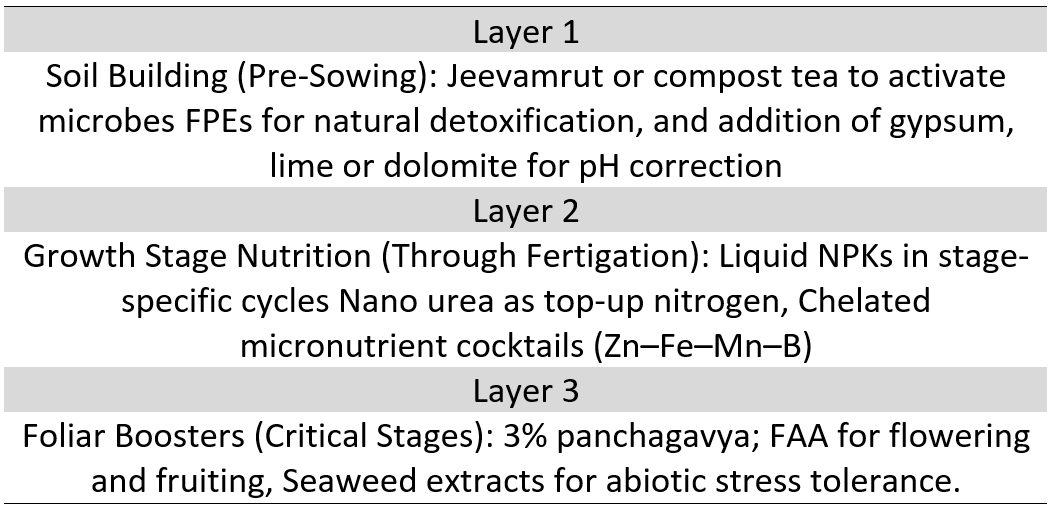
Adopted intelligently, this layered system can enhance NUE by 40–60%, reduce fertiliser use by 25–30%, and improve yields by 10–20%, depending on crop and agro-climatic zone.
Liquid nutrients reduce India’s fertiliser-related carbon footprint in three ways: Lower nitrous oxide emissions, improved soil structure, and reduced transport and storage losses. By synchronising nutrient supply with plant demand, liquid fertilisers reduce unutilised nitrate pools—the primary source of N₂O, a greenhouse gas nearly 300× more potent than CO₂. Microbial manures increase glomalin production, enhancing soil aggregation, water infiltration and root penetration. Nano and liquid fertilisers require far smaller quantities, cutting logistical emissions.
Challenges remain. There is limited knowledge among farmers about the preparation, storage, and scientific use of liquid manures. Fertigation infrastructure in rain-fed regions is inadequate. Inconsistency in quality among commercial liquid products is present. But opportunities are equally strong: FPO-led micro-biofactories for jeevamrut, panchagavya and compost teas—startups offering stable, shelf-ready bio-stimulants. Government incentives under PMKSY, PMPRANAM and PMFBY are available. Integration with soil sensors, IoT-enabled fertigation and AI-based nutrient advisories are coming.
Liquid manures and fertilisers represent more than a technical shift—they herald a new mindset for Indian agriculture. One that blends ancient microbial intelligence, cutting-edge nano-science, and precision agronomy. Together, they provide a pathway to regenerate soils, elevate nutrient efficiency, lower emissions, and empower millions of smallholders to produce more with less.
India has consistently demonstrated to the world how great revolutions start—whether through the Green Revolution, the White Revolution, or the Digital Transformation. The next, a Nutrient Efficiency Revolution, might originate not from granules but from drops of life-giving liquid that revitalise the soil and strengthen the plant. And if India succeeds once more, it will prove that the most minor shift in how we nourish the earth can ignite the most significant transformation in how humanity nourishes itself.
- Dr Gopal Lal, Prof Arun Tiwari



0 Comments