Indian agriculture sits on an uncomfortable truth: the average soil organic carbon (SOC) in our fields is under 0.5%. That “half-per cent problem” lies at the heart of many others—poor water retention, low nutrient efficiency, dwindling biodiversity, and fragile yields under climate stress. The antidote is not a single input or gadget; it’s a systems shift that steadily puts carbon back into soil and keeps it there. Technology can accelerate this shift, but it must be paired with smart agronomy, community organisation, and policy that rewards stewardship.
SOC is the engine of soil health. It aggregates soil particles (reducing erosion), holds water like a sponge, feeds microbes that unlock nutrients, and buffers pH and salinity. A small gain is big: for a typical mineral soil (bulk density ~1.3 g/cc) to 0–30 cm depth, increasing SOC by 0.1 percentage point adds roughly 3.9 t of carbon per hectare, equivalent to ~14.3 t CO₂e stored. Scale that across millions of hectares and you get healthier crops, fewer input shocks, and a real climate dividend.
What we see is years of bad practices fructifying like bad karma. Tropical heat and intense tillage accelerate decomposition, so carbon burns off fast. Residue removal/burning starves soils of organic matter. Unbalanced fertilization (especially overuse of urea) grows biomass but can degrade structure and micronutrient balance. Irrigation stress and salinity/sodicity in pockets (canal commands, coastal belts) further limit biology. Smallholders have limited capital, risk aversion, and fragmented landholdings, making long-term payback practices difficult. The goal must be to add carbon annually and slow its loss, making soils biologically active, structurally stable, and nutritionally balanced.
Technology can surely help. Affordable soil testing (including SOC, pH, EC, macro- and micro-nutrients) and handheld/portable spectroscopy can segment fields and avoid blanket recommendations. Decision Support Systems (DSS), fed by soil tests, weather, and crop stage, nudge farmers toward right-time, right-dose inputs and timely residue/cover-crop choices. Micronutrient mapping helps target zinc, boron, and sulphur—common deficiencies in India that limit biomass and root growth, thereby indirectly throttling carbon inputs.
Putting biology to work offers great promise. Microbial consortia (N-fixers, P-solubilisers, K-mobilizers, cellulolytic fungi) and bio-stimulants can accelerate residue breakdown, root exudation, and humus formation—if sourced reliably and applied with moisture discipline. On-farm rapid composting using forced-aeration pits, inoculated windrows, or covered heaps converts waste into stable organic matter in weeks, not months. Biogas + slurry management turns dung into energy; digester slurry is a nutrient-rich, biologically active amendment.
Carbon can be locked. Biochar from crop residues (rice straw, cotton stalks, pruned branches) produced in clean, farmer-safe kilns improves CEC, water holding, and microbial habitat. Blended with compost/manure, it reduces nutrient leaching and persists for years. Enhanced weathering (finely ground basalt/dunite on acidifying soils) is promising but site-specific; pair with trials and limestone/gypsum economics to avoid misapplication.
Precision application saves money and carbon. Variable-rate input tools (even simple rate controllers) prevent overuse, lower nitrous oxide risk, and keep soil life balanced.. Moisture sensors and tensiometers optimise irrigation—crucial because soil biology collapses under alternating drought and waterlogging. Monitoring, Reporting, Verification (MRV) at scale. Satellites, drones, and field plots can track biomass proxies, residue retention, and cover crop establishment. Digital MRV enables carbon programs to pay farmer groups for verifiable SOC gains and for the adoption of practices, reducing transaction costs that often exclude smallholders.
It is important to keep the soil covered. Residue retention/mulching is the quickest SOC win. Even partial retention (e.g., 30–50%) cuts evaporation, suppresses weeds, and feeds microbes. Where burning is entrenched, transition via in-situ incorporation tools or ex-situ straw markets for bioenergy/board-making, with some fraction returning as biochar or compost.
Growing roots for more months of the year is beneficial. Cover crops/green manures (dhaincha, sunn hemp, cowpea, horse gram) between main crops push carbon belowground, fix nitrogen, and break pest cycles. In rainfed Deccan and Bundelkhand, short-window legumes before rabi are game-changers. Pulses in rotation (tur, moong, urad, chana) build both protein and humus; intercropping pulses with millets or oilseeds spreads risk and deepens rooting.
Reduced tillage/zero tillage protects aggregates and slows carbon oxidation. Pair with residue management and balanced fertilisation; zero-till without cover/mulch can underperform. Millet–pulse–oilseed rotations in drylands; rice–fish–duck or rice–pulse in wetlands; horti-row crop alley cropping in peri-urban belts. Diversity feeds a broader underground food web, improving disease suppression and nutrient cycling.
Trees are living carbon ATMs. Agroforestry (guava, mango, jamun, moringa, tamarind; or timber like teak where water allows) and bamboo on bunds create vertical productivity and steady litterfall. Well-designed tree rows don’t rob crops; they buffer hot winds, raise SOC in strips, and add off-farm income through fruit, poles, and bio-materials.
Fix the problem at the root. Sodic soils respond to gypsum + organic matter + drainage; Acidic soils to lime + organics; Saline soils to leaching + organic amendments + salt-tolerant varieties. Getting the chemistry right reopens the door for biology—and carbon.
Farmers rarely get paid just for “carbon.” They adopt practices when they see lower diesel, fewer sprays, better soil tilth, and resilient yields. Demonstration plots run by FPOs or Panchayats convert sceptics faster than lectures. Aggregating hundreds of farmers into a single protocol reduces MRV costs and shares benefits fairly. Anchor buyers (mills, food brands, bio-material firms) can contract for residue, pay a “soil premium,” and co-invest in biochar/compost yards. Banks can bundle loans with soil tests and practice milestones, lowering interest for verified improvements.
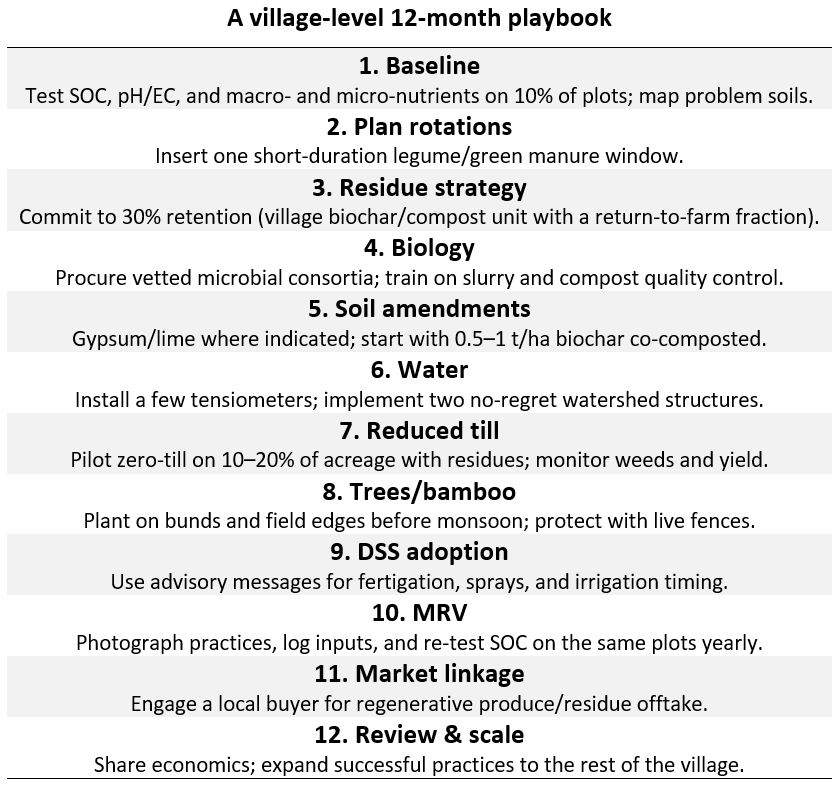
We are not offering a panacea. Biochar isn’t magic. If dusty or applied raw, blend with compost or manure. Microbial products vary; insist on quality assurance and store them out of the heat. Zero-till without cover can lead to compaction and weed problems; pair it with mulch and legume cover. And, more nitrogen ≠ , more carbon beyond a threshold—excess N can destabilise soil biology and increase losses.
Policy, research, and culture must converge. Public programs should prioritise living cover, residue management, watershed work, and micronutrient balancing over headline-grabbing but narrow subsidies. Research needs long-term SOC trials across agro-ecologies, integrating millets, pulses, and tree-crop systems; and open, farmer-first testing of microbial/biostimulant claims. Education and extension must shift from “input push” to “soil process literacy”—why roots matter, what aggregates are, how microbes eat. Celebrating soil stewards, running “Soil Days” in schools, and building pride in residue retention, as we did with sanitation.
If Indian soils rise from <0.5% to even 1.0–1.2% SOC over a decade, farmers will feel it in their palms: cooler soil, easier tillage, steadier crops, fewer shocks. The path is practical—keep the soil covered, grow roots longer, disturb less, feed biology, fix chemistry where broken, and use technology to measure, guide, and pay fairly. Soil management is not an expense; it’s compounding capital. Every season that we return carbon to the earth, the earth returns resilience to us.
- Dr Gopal Lal, Prof Arun Tiwari



0 Comments