ICAR-National Academy of Agricultural Research Management (NAARM) hosted a month-long Basic Training Programme for Assistant Directors, Official Language (OL), recruited directly in the Council from 09 March to 02 April, 2026, as ICAR took a determined decision to train newly recruited officers before their deployment in various institutes.
What distinguished this programme was not merely its duration or structure, but its deeper intent: to prepare a new generation of scientific administrators who understand that knowledge, by itself, does not transform systems—its transmission does. And at the heart of that transmission lies an often underestimated force: language.
In a country as vast and diverse as India, the journey of technology—from laboratory to land—is not linear. It is mediated by layers of interpretation, adaptation, and trust. Agricultural research, no matter how advanced, reaches its true fulfilment only when it is understood, internalised, and applied by farmers across varied contexts. This is where language ceases to be a mere medium of communication and becomes an active instrument of transformation.
The training programme at ICAR-NAARM recognised this subtle but decisive reality. Participants were not only exposed to scientific and administrative dimensions of research management but were also sensitised to how knowledge travels—and sometimes fails to travel—across boundaries.
Technology transfer in agriculture has often been viewed through infrastructure, funding, and institutional networks. While important, they are insufficient in isolation. Between invention and adoption lies a critical space—navigated through language.
This language operates at three interconnected levels:
- The technical layer (research papers, data models—precise but often inaccessible)
- The operational layer (actionable guidance—clarity and usability)
- The cultural layer (alignment with local practices, beliefs, and lived experiences)
It is at this cultural layer that many innovations falter. A farmer adopts technology not just because it is scientifically sound, but because it aligns with tradition, risk perception, and community experience. Language, therefore, is not just words—it is meaning.
India’s agricultural extension systems have long faced this challenge. Scientific communication confined to English creates a silent barrier. Even translation without contextual adaptation limits effectiveness, leading to a paradox: high scientific output but uneven adoption.
The NAARM programme encouraged a shift—seeing extension not as one-way dissemination, but as a dialogic, co-creative process. Here, language becomes a bridge, not a barrier.
This becomes even more critical in AI-driven agriculture. Technologies like mobile apps, sensor networks, and predictive analytics depend on interfaces that speak the farmer’s language—literally and contextually. Otherwise, they risk becoming tools of abstraction instead of empowerment.
This is where the Indian Council of Agricultural Research plays a pivotal role. The future depends on multilingual, culturally grounded knowledge ecosystems, integrating language at the design stage—not as an afterthought.
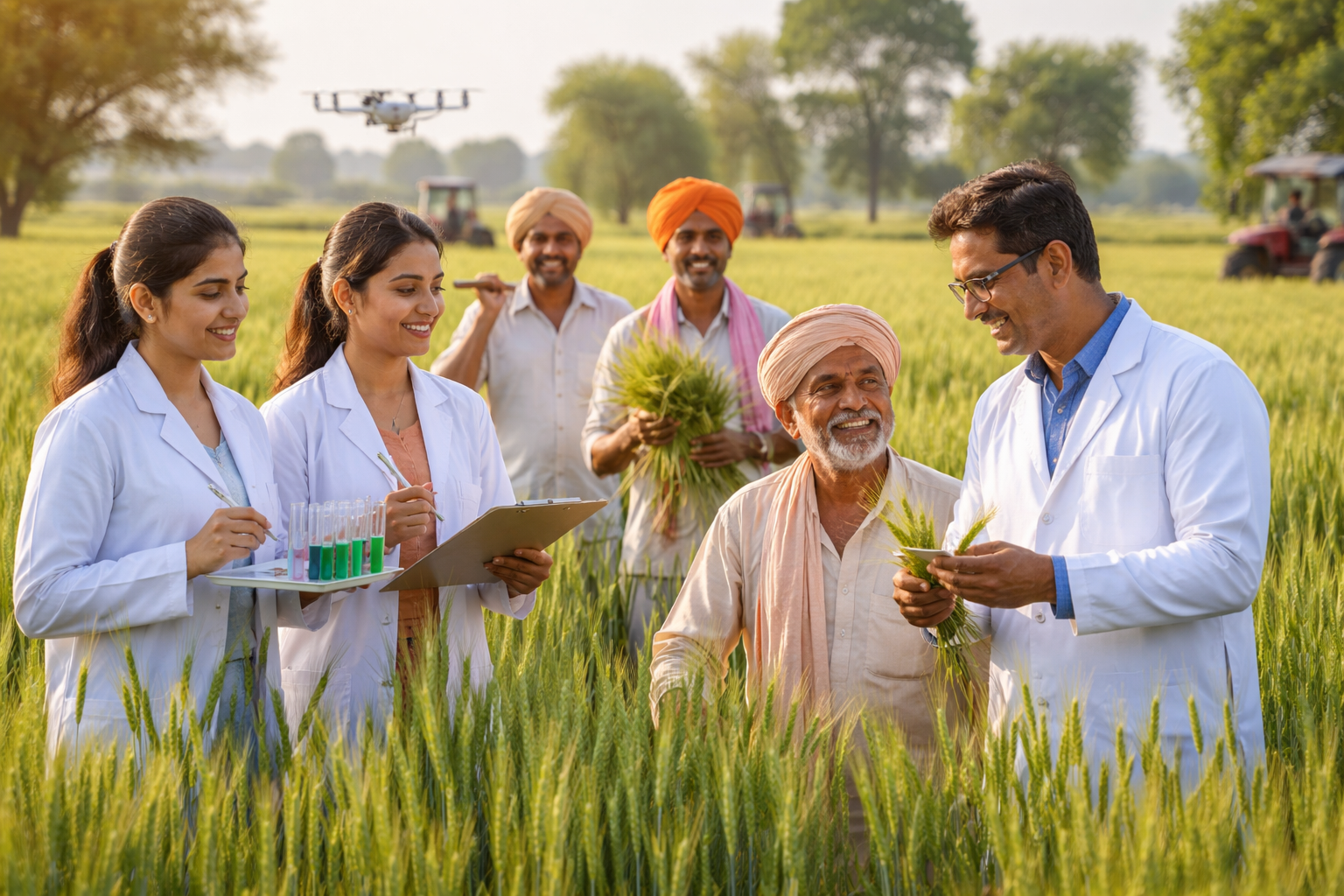
Equally important are human intermediaries—extension workers, field officers, and community leaders—who act as true translators, interpreting and embedding knowledge into local realities.
The young Assistant Directors trained at NAARM stand at an important threshold. They carry not just the responsibility of managing research, but the opportunity to redefine how knowledge flows in agriculture.
The NAARM training programme represents more than capacity building. It is a step toward reimagining agricultural innovation in India—where language is not just communication, but the foundation of meaningful and sustainable technology transfer.
- Dr. Gopal Lal with Prof. Arun Tiwari

0 Comments